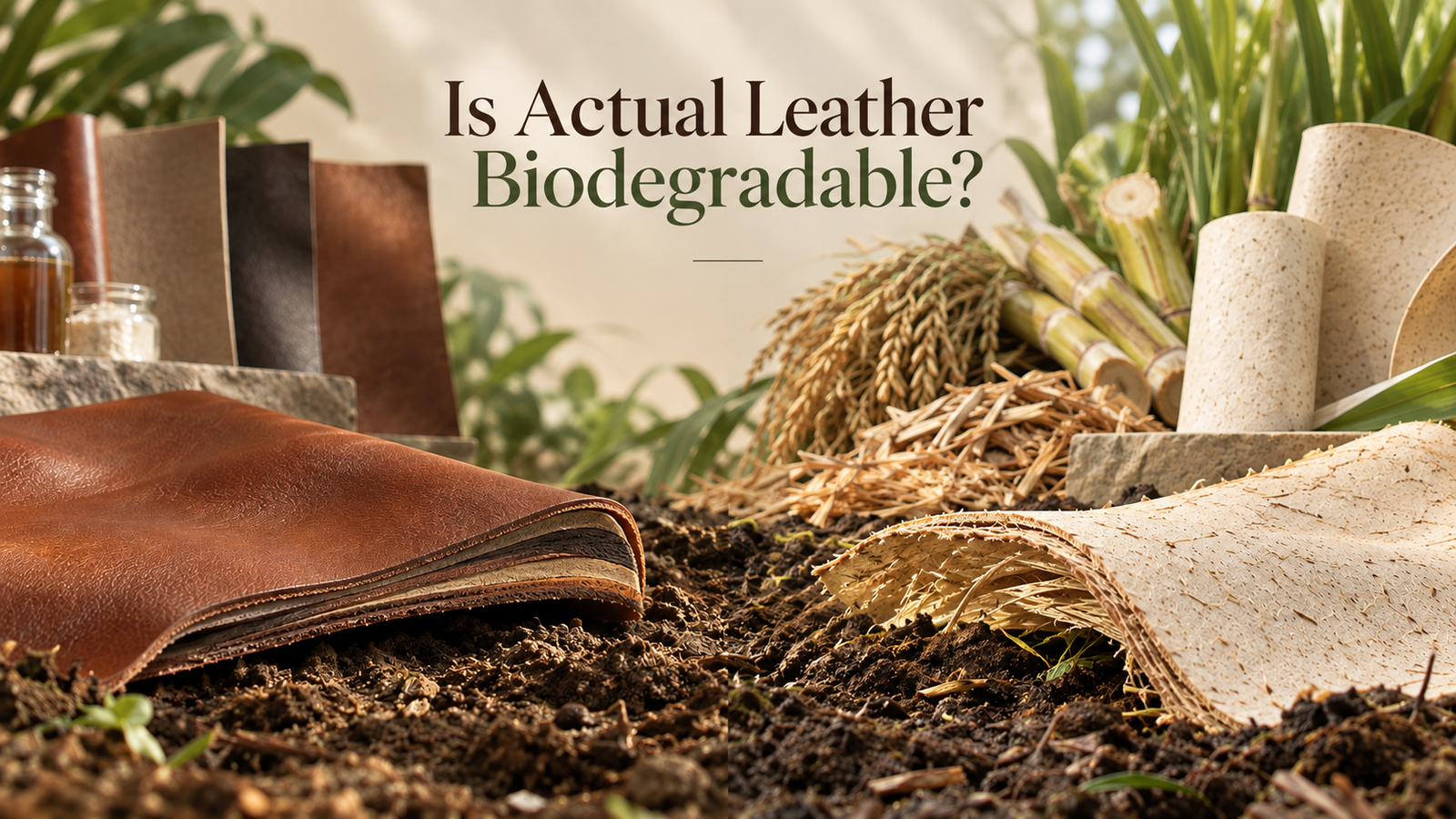
Is actual leather biodegradable? The short answer is: Leather comes from an animal-derived material, but that does not mean every finished leather product will readily be biodegradable in nature. the tanning, dyeing, coating, adhesives and finished processes can significantly affect what happens to leather at the end of its life.
This distinction is important when comparing actual leather with plant-based leather.
Is Rear leather naturally biodegradable?
Raw animal hide is largely made of collagen, a natural protein that microorganisms can break down. But leather is not sold as raw hide.
To make leather durable and resistant to moisture, hides undergo tanning and finishing processes. Chrome tanning, for example, uses chromium salts, and finished leather may also contain dyes, coatings and other chemicals. FAO reports that chromium is widely used in leather tanning and that tannery waste can contain chromium and other pollutants.
Therefore, saying “Leather is biodegradable because it comes from an animal” is an oversimplification.
Research also shows why the type of tanning matters, In one composting study, chrome-tanned leather showed no observed biodegradation under the tested conditions, while some chrome-free alternatives showed greater degradation.
So, biological origin does not automatically guarantee biodegradation of the finished product.
Is Plant-based Leather Automatically biodegradable?
Not necessarily
This is another common misconception.
Plant-based leather can be made using agricultural residues, fibres or other biological materials, but the complete formulation matters. Binders, coatings, pigments, adhesives, and synthetic components can influence how the finished material behaves after disposal.
That is why responsible claims should be based on testing the finished material, rather than simply looking at where its main raw material comes from.
What industry standards matter for biodegradablility?
If a plant-based material is intended to be described as industrially compostable, it should be evaluated against an appropriate recognized standard.
Standards such as EN 13432 and ASTM D6400 established requirements for materials designed for composting in controlled industrial or municipal facilities. These assessments consider factors such as biodegradation, disintegration and the effect of the resulting material on compost quality.
This creates an important distinction:
- Plant-based does not mean automatically biodegradable
- Biodegradable does not mean automatically compostable
- Compostable does not mean automatically home compostable
Credible sustainability claim should therefore be supported by testing and certification for the specific finished product and intended disposal environment.
What about SriJeevanam Plant-based Leather?
SriJeevanam uses a plant-based material made primarily from upcycled agricultural residue, combined with bio-based adhesive and other formulation components.
The important point is that SriJeevanam does not consider “plat-based” alone sufficient to claim complete biodegradability
The longer-term goal is to develop a material that can meet the appropriate industry standards for biodegradation or compostability. Once the complete material formaulation and finished product are tested and certified against the relevant standard, stroger claims about its end-of-life decomposition can be made.
That distinction matters because sustainability is not only about where a material begins-it is also about what happens to it when its useful life ends.
The Bottom line
Actual leather is made from a biological material, but finished leather should not automatically be assumed to be readily biodegradable. Tanning and finishing can change its end-of-life behaviour.
Similarly, Plant-based leather should not automatically be called biodegradable simply because it contains plant or agricultural materials.