The word recyclable, reusable and biodegradable are often used together when people talk about sustainable products. But they describe three very different things.
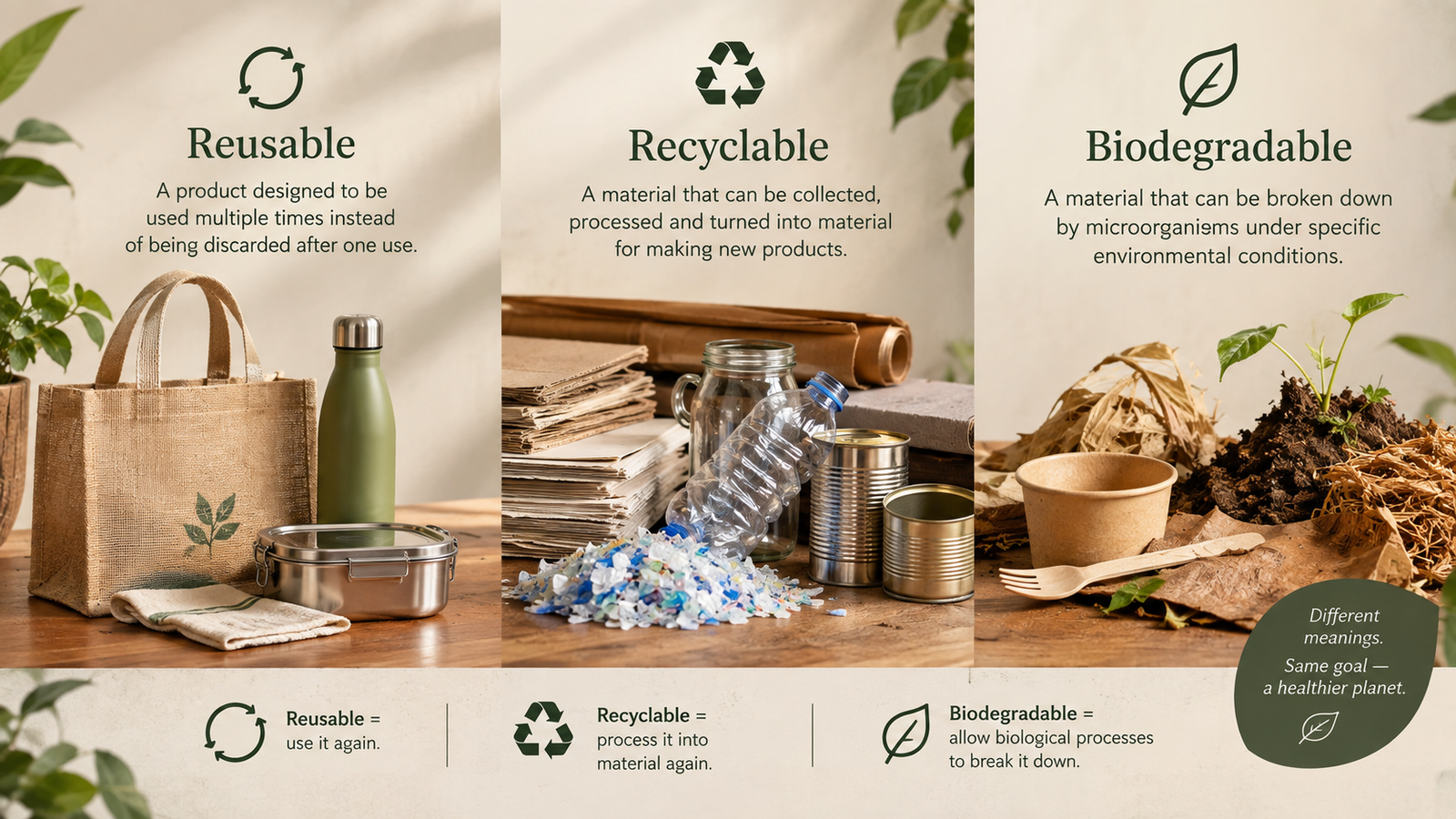
Reusable means a product can be used again. Recyclable means its material can be collected and processed into material for making new products. Biodegradable means a material can be broken down by microorganisms under specific environment conditions. Understanding the difference can help consumers make more informed sustainability choices.
What does reusable mean?
A reusable products is designed to be used multiple times instead of being discarded after one use.
A jute shopping bag, stainless-steel bottle or durable storage container can be reusable. The environment benefits comes from extending the product’s useful life and potentially avoiding the need for new single-use products
The U.S. environmental protection Agency(EPA) places source reduction and reuse ahead of recycling in its waste-management hierarchy.
However, simply calling something reusable does not tell us how sustainable it is. Its durability, number of uses, maintenance and material composition also matter.
What does recyclable mean?
Recyclable means that a product or material can be collected, processed and turned into material that can be used to manufacture new products
For example, certain paper, glass, metal and plastics can enter recycling systems.
But there is an important distinction between “recyclable” and “recycled”
A recyclable product can potentially be processed. A recycled-content product already contains recovered material.
Recycling also depends on available collection and processing infrastructure. A product labelled recyclable may not actually be recycled if suitable facilities or collection systems are unavailable in a particular location.
What does biodegradable mean?
Biodegradable refers to a material’s ability to break down through biological activity under particular conditions.
It does not necessarily mean that a product will disappear quickly in soil, water or a landfill.
The European commission explains that even biobased materials are not automatically biodegradable, and biodegradable materials may require specific conditions to break down.
This is why claims such as “biodegradable” or “compostable” should be considered together with the conditions and standards behind the claim.
Reusable vs Recyclable vs Biodegradable: What’s the difference?
| Term | What it means | Main idea |
|---|---|---|
| Reusable | Used multiple times | Extend product life |
| Recyclable | Processed into material for new products | Recover materials |
| Biodegradable | Broken down biologically under suitable conditions | End-of-life decomposition |
These approaches are not competitors. One product can potentially be reusable and recyclable, while another may be reusable but not biodegradable.
Which is more sustainable?
There is no universal answer.
A durable product that is used repeatedly can avoid the need for multiple replacement recycling can help recover valuable materials when reuse is no longer pactical. Biodegradability can be relevant when a material reaches an appropriate end-of-life pathway.
The EPA’s waste hierarchy therefore emphasises reducing comsumption and reusing products before recycling where possible.
Instead, ask:
How long will I use it? Can I reuse or repair it? Can its material actually be recycled? And what happens when its useful life ends?
How is SriJeevanam connected with Reusable, Recyclable and biodegradable choices?
SriJeevanam explores conscious product design by using material such as jute and upcycled agricultural-residue-based materials to create everyday products designed for repeated use. From reusable jute accessories to plant-based material products, the focus is on reducing dependance on conventional materials while being transparent about what each material can and cannot claim. Rather than assuming that every plant-based product is automatically biodegradable or recyclable, SriJeevanam consider material composition, durability, reusability and end-of-life when developing its products.