A plant-based leather or agricultural waste based leather alternative can be a more responsible material choice when it genuinely uses a waste or residue stream, reduces dependence on virgin resources and is manufactured thoughtfully. But its sustainability ultimately depends on much more: what the agricultural residue replaces, how much of it is actually present in the material, what other ingredients are used, How long the manufactured, how long the finished product to it at the end of its useful life.
Thai distiction matters when we talk about plant based leather and sustainable alternatives to animal leather.
From Agricultural waste to Plant based Leather
Every Harvest leaves something behind. Depending on the crop, this can include stalks, husks, leaves, fibres and other agricultural residues.
Some of these residues have useful applications, while others may be burned, discarded or left with limited economic value.
Open burning is not a harmless disposal method. A national study by science direct estimated that crop residue burning in India generated approximately 991,000 tonnes of PM2.5, 1.23 million tonnes of PM10 AND 11.2 million tonnes of carbon monoxide annually, based on 2018 activity data. The same study estimated emissions of black Carbon, organic carbon, nitrogen oxides, Sulphur dioxide, VOCs, methane and Carbon dioxide.
Also, I read a report which states that burning rice residue releases particulate matter, carbon monoxide, carbon dioxide and nitrogen oxides, while also resulting in the loss of nutrients and organic carbon from the soil. this got u thinking and we made our life a little more difficult in becoming a company using materials from waste only not from Virgin sources.
But there is an important catch.
Agricultural waste does not Automatically means 100% Plant-based.
A plant-based leather material is not necessarily made entirely from agricultural waste.
Most high-performance leather alternatives are composite materials. They may contain plant fibres or agricultural residues along with binders, coating, adhesives, fillers, pigments and other components required to give the material flexibility, water resistance and a consistent finish.
Research published in the Journal of Renewable Materials in 2025 found that the bio-based content of different plant-based Leather alternatives varies considerably. Some materials contain high proportions of plant derived material while still using PU and coatings.
This is why simple calling something “Plant based Leather” does not tell you enough.
You need to know what is inside the material.
It isn’t.
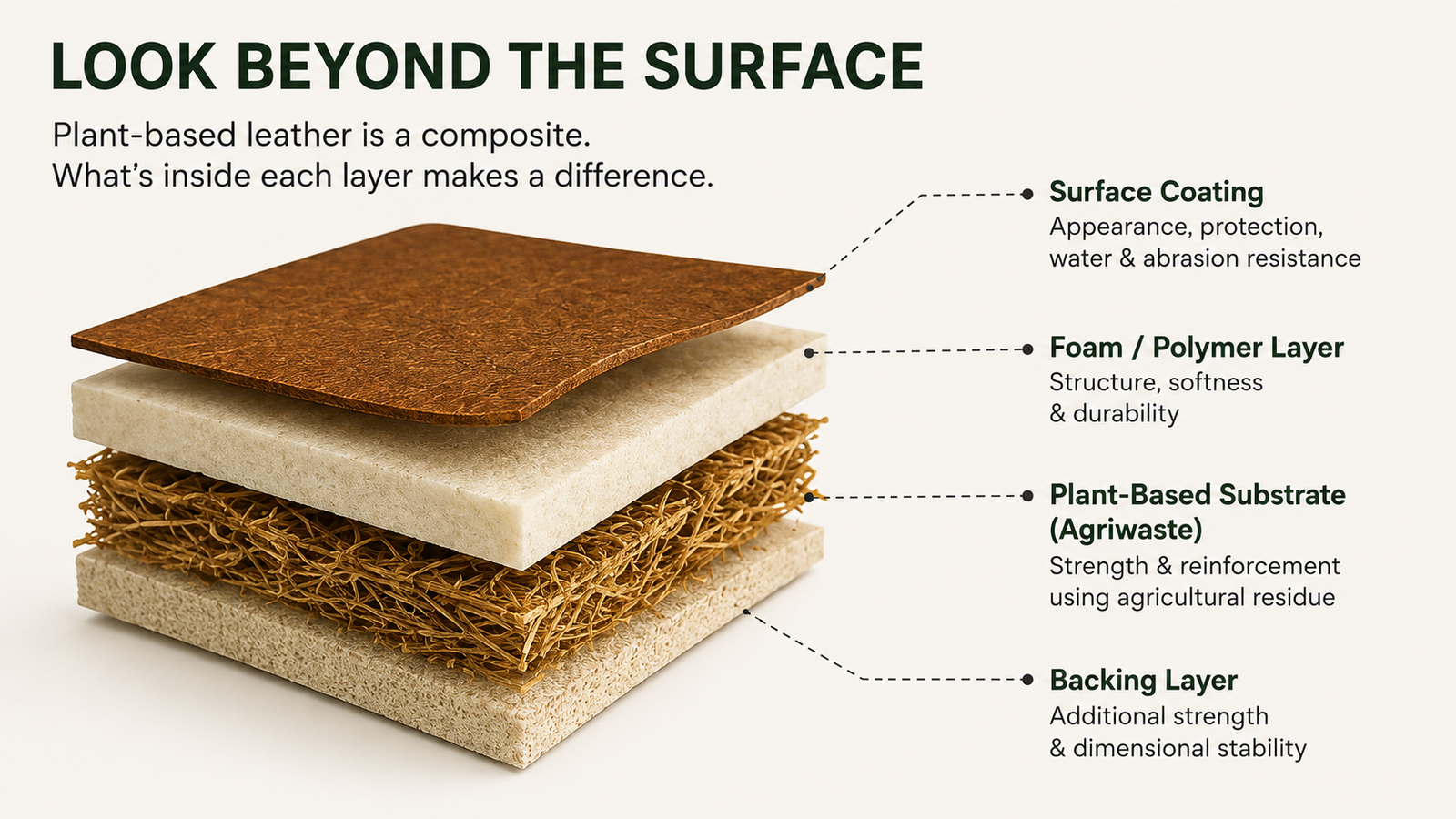
A cross-sectional view can tell us much more.
There may be a surface coating that provides the appearance and protection, a foam or polymer layer that gives structure and softness, a plant based or agricultural waste substrate that provide additional strength and stability.
The environmental story can therefore change depending on what each layer contains.
What type of binder holds the fibres together? What type of coating is used? What adhesive joins the layers? Is the adhesive solvent based or Water based?
Are the polymers fossil based or party bio based?
These questions matter because the sustainability of a composite material depends on its complete composition, not just its headline ingredients.
What About PU?
This is where the conversation needs some heonesty.
Polyurethane, or PU, is widely used in leather alternatives because it can provide flexibility, durability, Abrasion resistance and a consistent surface finish.
But conventional PU is largely based on petrochemical feedstock.
That does not mean PU itself has to disappear from the material equation. Research from material Polyurethane is already exploring plant-derived feedstocks such as vegetable oils and other renewable biological sources as alternatives to conventional fossil derived raw materials
However, bio-based PU does not automatically mean completely petrochemically free PU. Depending on the formulation, only some of the polymer’s building blocks may be derived from renewable sources. This distinction is important when making sustainability claim. We never make claims that it is without PU, Our material composition against each product reveals it. Rather than just asking, It has PU or not, better question are: What type of PU is being used, where do its raw materials come from, and what role does it play in the material?
How We approach Plant based Leather at SriJeevanam
At SriJeevanam, We use a Plant based material in which 60% upcycled agricultural residue.
The material also uses a polymeric coating and binder sysytem to achieve the performance required for everyday products.
For the formulation we use different materials and we declare the composition for one of the material compositions is approximately60% upcycled agricultural residue, 30% bio-based adhesive and 10% fillers, Protein binder and pigments, with the PU component accounting for approximately 1% of the formulation.
We also use a PU foam coating backed by agricultural residue, cotton backing and water-based adhesive in our construction.
This is important to us because sustainability should not stop at the first ingredient.
So, Is plant based Leather sustainable?
The honest answer is that it can be a more responsible material choice, but the label alone does not prove sustainability.
A plant-based leather alternative should be evaluated on its material composition, the percentage of bio based or waste derived content, the source of its polymers and binders, its manufacturing process, durability, resource consumption and end of life pathway.
This is also why we don’t believe in simply saying: “It is made from agricultural waste, therefore it is sustainable”
That is too easy. We believe that consumers and businesses should ask better questions