Today, words such as eco-friendly, green, sustainable, natural, biodegradable, carbon-neutral and planet-friendly appear everywhere-from clothing and beauty products to packaging, accessories and food. But how do you know whether an environment claim is actually meaningful?
This is where greenwashing becomes important.
Greenwashing is the practice of creating an exaggerated, vague, misleading or unsupported impression that a product, service or company is environmentally responsible. It can happen when a brand highlights one positive environmental feature while leaving out important information about the product’s overall environmental impact.
The problem is significant. The European commission reports that 53% of environmental claims examined in the EU were vague, misleading or unfounded, while 40 % had no supporting evidence. The commission also identifies more than 230 environmental labels in the EU with varying levels of transparency.
Why is Greenwashing a problem?
Sustainability claims influence purchasing decisions. When environmental information is unclear or exaggerated, consumers may pay more for a product believing it has a significantly lower environmental impact than it actually does.
It can also make genuinely sustainable businesses harder to distinguish from businesses using sustainability mainly as a marketing message.
That is why sustainable marketing should be based on specific, measurable and verified information-not just attractive environmental language.
What are common examples of Greenwashing?
Greenwashing does not always mean that a company is deliberately lying. Sometimes the problem is that a claim is too broad, incomplete or impossible for consumers to verify.
Watch carefully when you see claims such as:
- “100% eco-friendly”
- “Completely green”
- “Plaet-safe”
- “Zero impact”
- “Natural”
- “Sustainable”
- “Biodegradable”
- “Compostable”
- “Made with renewable materials”
These words are not automatically greenwashing. The problem is making them without explaining what exactly they mean and what they evidence supports them.
The U.S. Federal trade commission’s specifically caution businesses against broad, unqualified claims such as “green” or “eco-friendly” because they can imply much wider environmental benefits than a company may actually be able to substantiate.
How can you spot Greenwashing?
- Look for specific Information
Instead oof simply saying ” Sustainable material,” a responsible brand should expalin what the material is made from.
For example:
Vague:
“Made with sustainable materials.”
More useful:
“Made with 60% upcycled agricultural residue.”
Specific information gives consumers something they can actually evaluate.
2. Ask: What percentage is actually Sustainable?
A product may contain a small amount of recycled, renewable or plant–based material while the majority consist of conventional materials.
Look for information about material composition, coatings, adhesives, synthetic components and percentages.
The FTC recommends that recycled-content claims identify the amount of recycled material when a product is only partly made from recycled content.
3. Does “Biodegradable” mean anything specific?
Biodegradable, compostable and recyclable are not interchangeable terms.
A product can contain plant-based ingredients without the complete finished product being biodegradable.
If a company claims that something is compostable or biodegradable, look for the testing conditions, applicable standard, certification and intended disposal environment.
The FTC says compostable claims should be supported by competent and reliable scientific evidence showing that the product or packaging can break down safely under the claimed conditions.
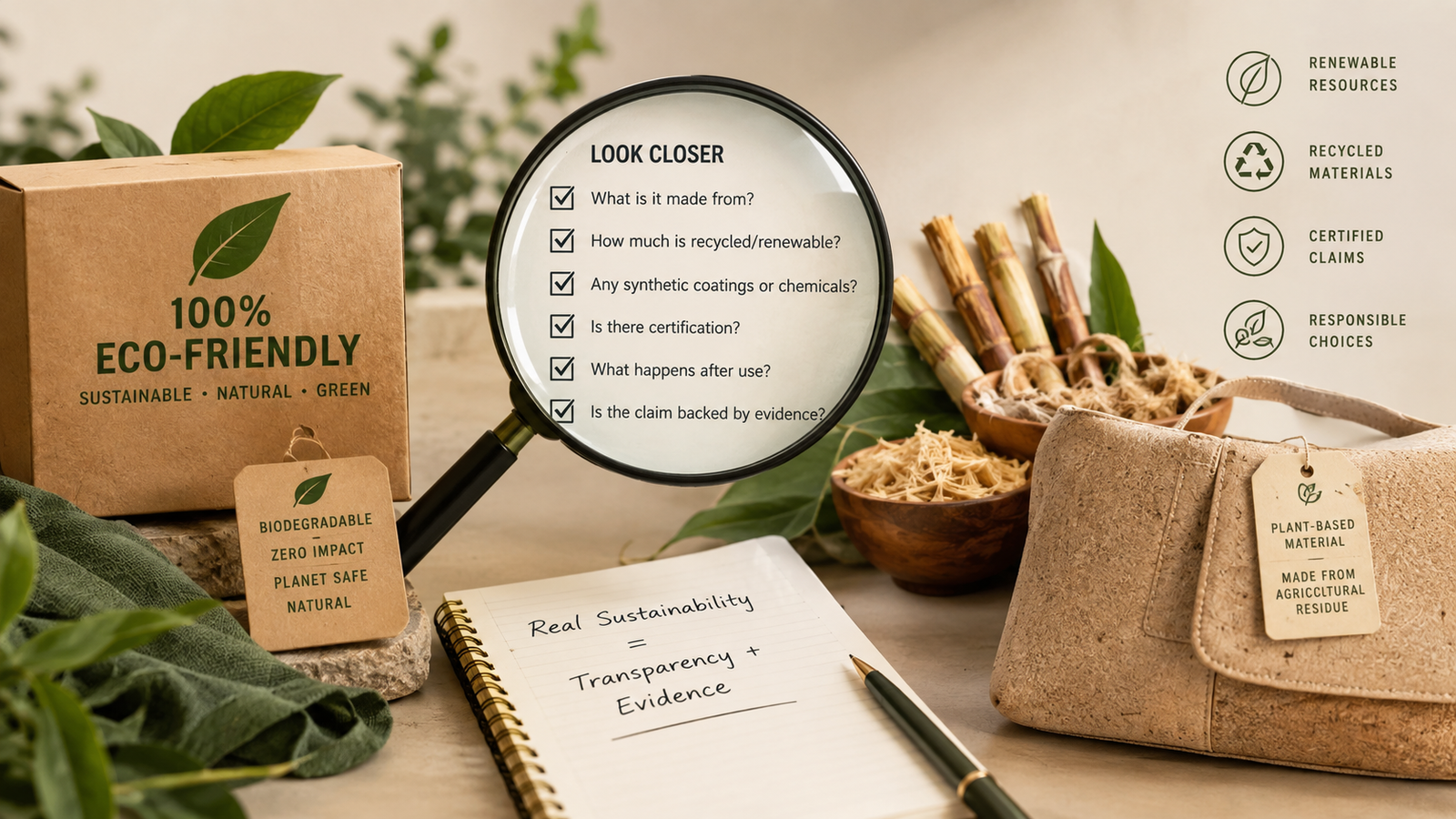
4. Look beyond the Front of the Packaging
Greenwashing often becomes easier to spot when you look beyond the headline claim.
Ask:
- What is the product actually made from?
- How much of it is recycled or renewable?
- Does it contain synthetics coatings?
- What happens after use?
- Can it be repaired or reused?
- Is there a take-back or recycling system?
- Is the environmental claim independently verified?
A leaf symbol or green-coloured package is not evidence of sustainability by itself.
Are Certifications always proof that a product is Sustainable?
Not necessarily.
A certification can be useful, but consumers should understand who issued it, what was tested, what criteria were used and which part of the product was certified.
The FTC notes that environmental seal and certifications should provide enough information to understand their meaning and the environmental attributed evaluated. Even third-party certification does not automatically substantiate every environmental claim a company makes.
What does responsible Sustainability communication look like?
A responsible brand does not need to claim that its product is perfect.
In fact, Transparency can be meaningful than perfection.
For example, instead of saying:
“Our product is completely sustainable.”
A more transparent approach would explain:
“Our material contains upcycled agricultural residue, and we are continuing to evaluate its end-of-life performance against relevant industry standards.”
The second statement tells consumers what has been done, what is known and where further work is needed.
How Does this Apply to Plant-based Leather?
The term plant-based leather itself should not be treated as proof that a product is automatically sustainable.
Plant-based materials can differ considerably in their composition. Some may use agricultural waste or plant fibres but also contain polymer binders, coatings or other synthetic components.
Therefore, consumers should ask:
What percentage is plant-based? How is it made? How durable is it? What chemicals or binders are used? And What happens to the material at the end of its life?
This is especially important when comparing plant-based leather, vegan leather, PU leather, and PVC leather.
The SriJeevanam approach
At SriJeevanam, the focus is on being specific about materials rather than relying only on brad sustainability words.
SriJeevanam’s plant-based material is made using upcycled agricultural residue, bio-based adhesive and other formulation components. The brand’s material information explains its composition instead of simply describing the product as “green.”
And importantly, plant-based does not automatically mean biodegradable. SriJeevanam’s approach is to recognize that end-of-life claims should be supported by appropriate testing and industry standards rather than assumptions based only on the origin of the material.
That distinction is important because sustainability is not a label-it is a set of measurable choices across a product’s lifecycle.
Final thought: How do you avoid Greenwashing?
The easiest way to spot greenwashing is to look past the green words.
Don’t ask only:
“Does this brand call itself sustainable?”
Ask:
“What exactly is the environmental claim, what evidence supports it, and what information is being left out?”
A genuinely responsible sustainability claim should be specific, transparent, relevant and supported by evidence.
In a market where environmental claims are becoming increasingly common, learning to question those claims is not being negative about sustainability. It is how consumers can make better-informed choices-and how responsible brads can earn trust.